


Quick Answer
An ultrapure water system reduces contaminants to application-specific limits and maintains water quality through controlled production and distribution. This guide compares piping materials, valve design, surface finish, and monitoring requirements for semiconductor, pharmaceutical, and laboratory applications. HEYI produces sanitary fittings and valves in-house and supports component selection with inspection records.
How Does UPW Production Work?
Treatment Stages
Reverse osmosis (RO) removes much of the dissolved salt and other contaminants. Electrodeionization (EDI) reduces remaining ions using ion-exchange media, membranes, and electrical current.
A polishing mixed bed can remove residual ions after these treatment stages. UV treatment, degassing, and final filtration address additional contaminants according to application requirements.
Water Production Flowchart
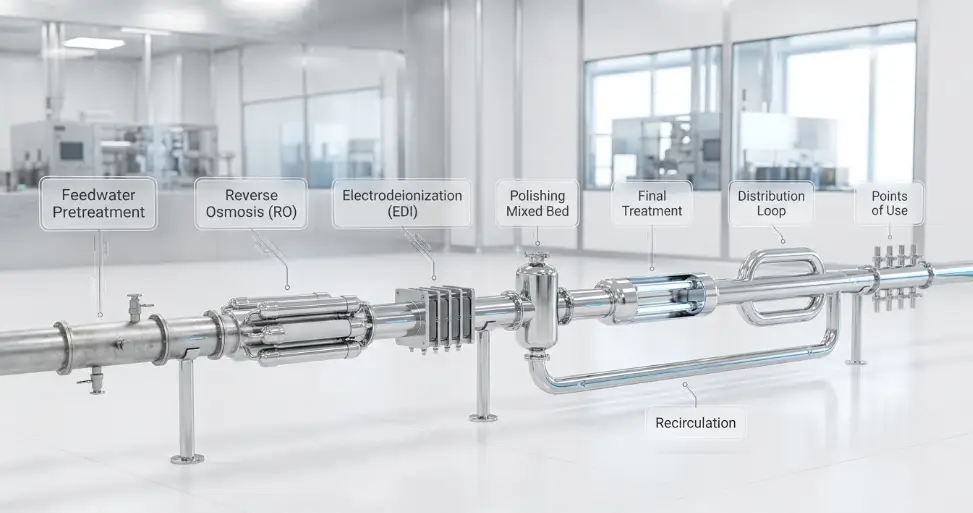
This simplified arrangement illustrates one treatment sequence; actual equipment and recirculation paths vary.
How Do UPW And WFI Requirements Differ?
Application Priorities
Semiconductor UPW protects wafers from trace metals, particles, organics, and other process contaminants. Laboratory water specifications depend on analytical methods, instruments, and experimental sensitivity.

Water for Injection (WFI) serves pharmaceutical applications requiring compendial chemical purity and endotoxin control. Bulk WFI differs from packaged Sterile Water for Injection, which undergoes sterilization.
Consequently, strong resistivity results alone cannot demonstrate compliance with pharmaceutical WFI requirements.
When Does 316L Suit Ultrapure Water Piping?
Material Selection
316L offers molybdenum-enhanced corrosion resistance, while low carbon content supports welded hygienic construction. However, neither 316L nor 304 guarantees freedom from metal release during service.
Our 304 versus 316L comparison explains alloy differences relevant to sanitary component selection.
A “316L fittings water purification” specification must define weld quality, surface finish, and seal compatibility. Semiconductor distribution also uses qualified PVDF and PFA, so 316L is not universally mandatory.

Application Example
An illustrative pharmaceutical loop may favor 316L for repeated hot-water sanitization. A wafer-rinse loop may favor fluoropolymers when controlling trace-metal contribution takes priority.
Which Valves Suit UPW Distribution Duties?
Component Comparison Matrix
| Component | Typical Duty | Design Consideration |
| Diaphragm Valves | Hygienic isolation | Drainability; diaphragm compatibility |
| Ball Valves | Drainage or switching | Seat cavities; retained water |
| Check Valves | Reverse-flow control | Cracking pressure; cleanability |
| Sanitary Pipe Fittings | Pipe connections | Bore alignment; gasket intrusion |
Geometry And Compatibility
Diaphragm valves isolate the operating mechanism from water without conventional stem packing. Their installed orientation and body geometry determine drainage and retained volume.
Ball valves require cavity assessment; a sanitary label does not establish complete drainability. Check valves reduce reverse flow but do not replace validated contamination controls.
Which Surface Finishes Suit High-Purity Water Service?
Roughness And Surface Condition
Ra measures average surface roughness; it does not describe every surface defect. Pharmaceutical specifications may reference ASME BPE finish designations alongside weld and surface acceptance criteria.
A semiconductor specification may set Ra ≤ 0.25 μm for selected metallic components. That value is a project requirement, not a universal UPW industry threshold.
Laboratory ultrapure water fittings likewise need finishes matched to their intended analytical duties. RFQ shorthand such as “mirror polished pipe ultrapure” needs measurable finish and cleanliness requirements.
Mechanical polishing reduces roughness, while electropolishing removes surface material through an electrochemical process. Passivation addresses surface chemistry; these treatments do not replace finished-component inspection.
How Does Dead Leg Control Protect Water Purity?
Branch Layout
A dead leg is a branch that receives little circulation or flushing during normal operation. Water retained in these pockets can support microbial growth, even when the main distribution loop circulates continuously.
For example, a long connection between the loop and sampling valve can retain water between sampling events. Positioning the valve close to the circulating line reduces retained volume and improves flushing.
Our dead leg elimination guide explains how branch dimensions, valve placement, and drainability influence hygienic piping design. Short connections and documented flushing procedures help control stagnation, while representative sampling checks water quality against defined limits.
How Should Sampling And Quality Monitoring Work?
Complementary Measurements
Online resistivity and total organic carbon (TOC) instruments track different contamination indicators. Particle, microbial, and endotoxin measurements supplement these indicators where the application requires them.
Our sampling valve guide covers designs used to collect representative water samples.
For a high-purity water system, sampling technique also affects measured results and contamination risk. Exposure to air can introduce carbon dioxide and alter offline resistivity readings.
The UPW system monitoring plan therefore connects instrument locations with representative sampling points.
How Can HEYI Support Component Specifications?
Since 2014, HEYI has manufactured sanitary valves, hygienic fittings, and stainless steel equipment. Our documented checks include material analysis, surface roughness measurement, pressure testing, and sealing verification.
Inspection reports and batch traceability support integration into an ultrapure water system. Explore our collection above, then submit an RFQ with dimensions, operating conditions, finish requirements, and documentation needs.
Frequently Asked Questions
1. Is 316L Required Everywhere?
No; qualified polymer piping also serves semiconductor distribution where contamination limits favor nonmetallic materials.
2. Does Mirror Polishing Prove Water Purity?
No; measured roughness, cleanliness, joining quality, and operating performance require separate assessment.
3. Can Resistivity Replace TOC Testing?
No; resistivity indicates ionic contamination, while TOC measures a different contamination category.
